The Hermes Dilemma
It's easy to fall into the Hero's myth. You build something from scratch. You hold it all together. You sacrifice. You solve. But heroics don’t scale well. And they rarely end cleanly. They end in exhaustion, disillusionment, and often, resentment.

When I worked in education, I didn’t just lead a school — I became it.
At least that’s how it felt. I was the face, the fixer, the fallback. If I stepped away, something would break. It wasn’t ego—just the slow erosion of boundaries over time, especially in a mission-driven context. I’ve seen it happen to countless teachers, school leaders, and founders. Eventually, the role starts speaking louder than the person inside it.
⸻
In my early twenties, I thought I had found it—the work that would fulfill me. Teaching felt like a calling, not a job. It offered all the purpose and moral clarity I’d longed for, especially after watching my family burn out in meaningless labor. My mom cleaned houses and worked at a video store. My uncles broke their backs doing construction and ended up on disability. Work, in my world, was something you survived. I wanted mine to matter.
And it did. But only because I gave everything to it. I worked nights, weekends, holidays. First one in, last one out. I graded papers on Thanksgiving and answered parent emails on Sunday nights. And I was rewarded for it—promotions, recognition, leadership roles. By my early thirties, I was a school director, shaping institutions and influencing the field of history education.
I thought I had made it. I thought I was thriving.
But my body and mind were already showing signs of collapse. I just assumed that was the price. That this is what impact looks like. That if the mission is good, the exhaustion must be too.
What I didn’t see then was how fully I had collapsed into the role. My identity, my worth, my world—all fused with the work. It took stepping away to realize how much I had sacrificed at the altar of purpose. How much I had confused being irreplaceable with being whole.
⸻
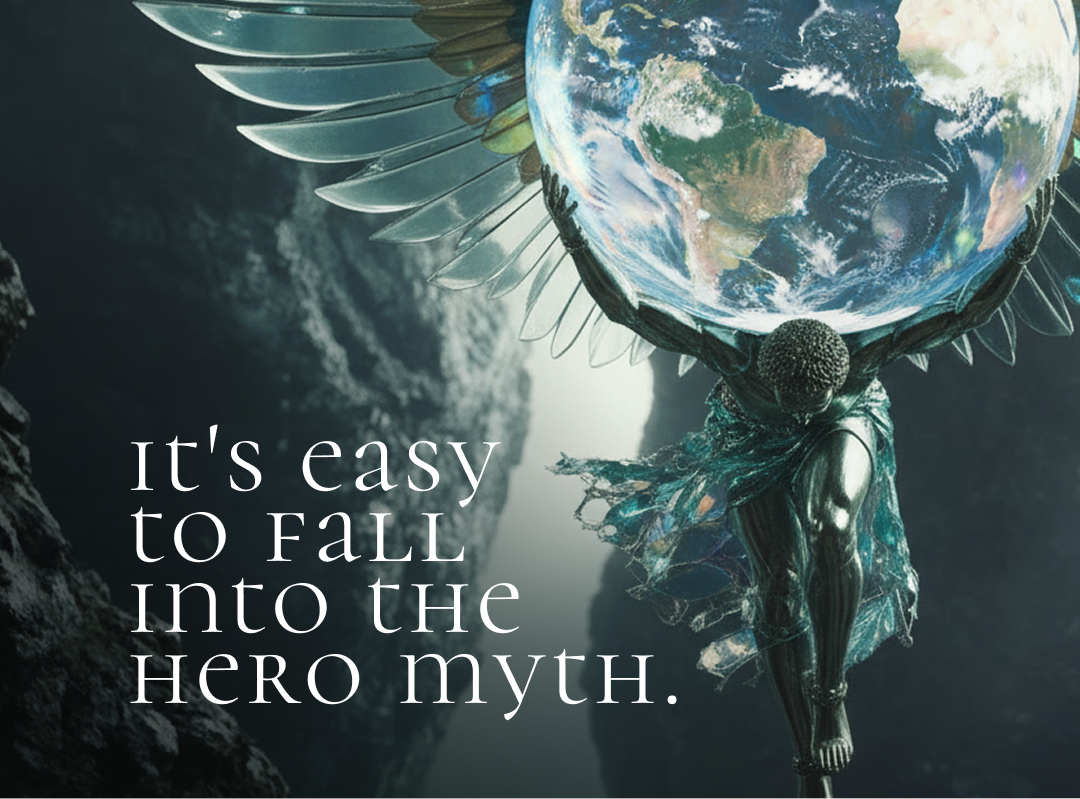
So when I stepped into the world of creative work and launched a studio, I told myself I’d build something with better balance and to bring the awareness of my pattern into this new realm. But also immediately, I noticed the pattern followed me. The same fusion of self-worth with output; of holding Atlas’ weight on my shoulders. So funny, how curious, I thought to myself. The patterns were slower, more subtle this time, but I knew what to look out for. Why, because I have played this pattern out several times in my twenties and early thirties.
What I began to realize is that this wasn’t just burnout—it was a more subtle kind of possession. The kind that happens when the story you’re telling about your work becomes indistinguishable from who you think you are. My laptop glowed at 1am while my partner slept in the next room. I couldn’t stop.
From Hero to Hermes
It’s easy to fall into the hero myth.
Many founders do—especially those coming from education, tech, social impact, or creative work. You build something from scratch. You hold it all together. You sacrifice. You solve. But heroics don’t scale well. And they rarely end cleanly. They end in exhaustion, disillusionment, and often, resentment.
Sometimes what looks like “ego” is something more complex.
Ego isn’t the enemy
It’s a vital part of being human. It’s the part that says I am, that recognizes the self as distinct from others. That very separateness is what allows us to extend gratitude, to make beauty for one another, to create boundaries and art and structure. Older traditions didn’t vilify the ego—they initiated it. They asked it to grow up, to serve something larger than itself.
The problem isn’t ego. It’s an uninitiated ego
One that confuses its uniqueness for superiority, or its vision for the whole. That’s the voice that says, “Only I can carry this,” or “If I let go, it will all fall apart.” It’s a subtle drift from responsibility into over-responsibility. And that’s where another myth enters: Atlas.
Atlas isn’t a hero. He’s a figure of punishment—doomed to hold up the sky alone. Immobilized by duty. Revered, perhaps, but never relieved. I’ve stood in that posture before—back tight, inbox full, deadlines stacked like sky. For a while, I believed it was noble. Necessary, even. But over time, something in me started to erode. The more I carried, the less I moved. The more I absorbed, the less I created. That weight wasn’t mine to hold alone. It’s a cautionary tale—how easy it is to confuse being essential with being trapped.
There’s another figure I’ve come to find more useful:
Hermes.
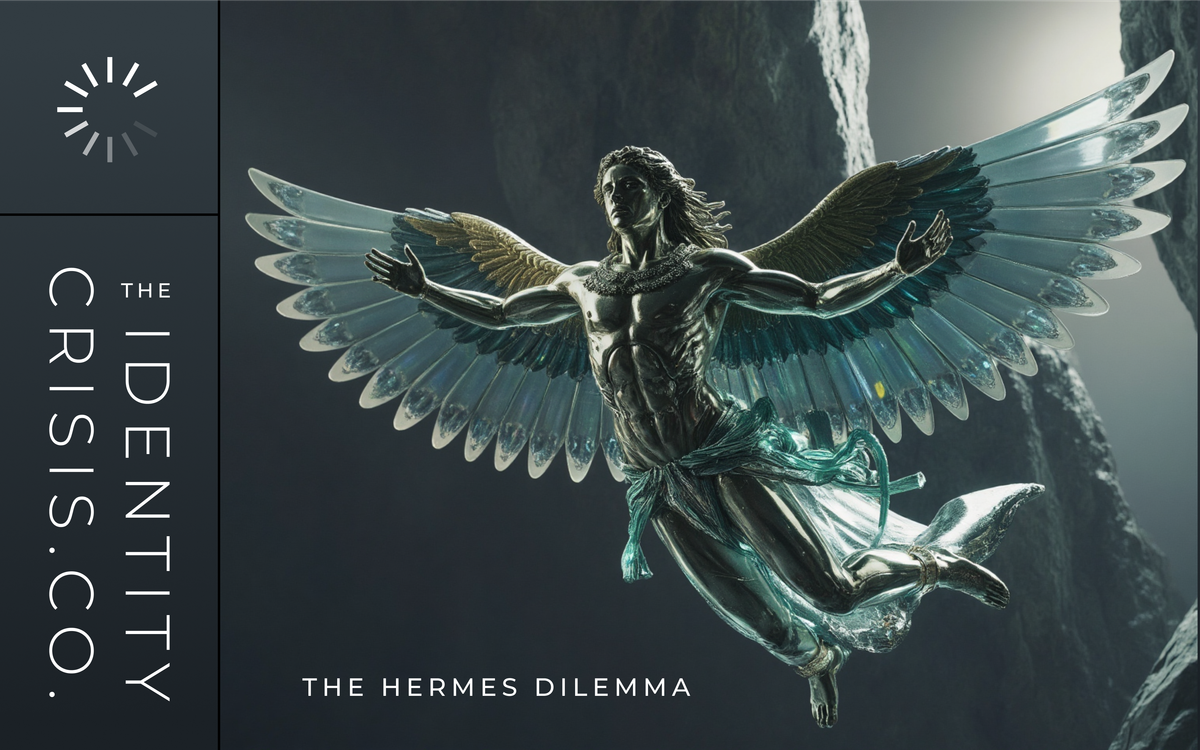
Hermes doesn’t carry the world. He carries the message. He moves between realms. He delivers what’s needed, then steps aside. He’s not collapsed into his offering—he’s in relationship with it. That’s the leader I want to be, a messenger, in motion—clear, nimble, and able to walk away when the time is right.
That’s what I think many of us are being asked to become. Not heroic leaders. Not martyrs for the mission. But translators. Interpreters. Guides for something that moves through us—but is not us.
⸻
Merchants, Thieves, and Travelers
Hermes was also the god of merchants, thieves, and travelers.
It’s an odd trio, until you consider how much of modern creative and entrepreneurial work lives in those categories.
- Merchants, trading in offerings, building businesses, navigating value exchange.
- Thieves, borrowing from aesthetics, cultures, ideas—sometimes honoring, sometimes grifting.
- Travelers, always on the move, pivoting, evolving, shapeshiffing, rarely rooted for long.
All three carry risk when we stop paying attention. The merchant becomes extractive. The thief loses accountability. The traveler forgets to return.
What’s asked of us is not perfection, but consciousness.
To know the roles we’re in. To name the shadows we carry. To build businesses without letting them consume us.
⸻
You Are Not the Brand
If there’s one thing I’ve learned—sometimes the hard way—it’s that you can be deeply committed to the work without becoming the work.
Your brand is not your self. Your studio is not your soul. And your value doesn’t rise and fall with your output.
You can build with care, deliver with integrity, and still let the thing live apart from you.
Hermes didn’t carry messages because he needed recognition. He carried them because they weren’t his to keep.
Maybe the same is true for what we’re building. So here is a note from Hermes:
Relax your shoulders.
Set the world down—just for a moment.
Try on my winged boots.
Maybe we don’t have to carry it all.
Maybe we could fly instead.
Zach Seagle
Financial Director
The Identity Crisis Co.